
Resource Library
-
EPA Climate Pollution Reduction Grant Comprehensive Climate Action Plan (CCAP)
MTERA has created a Comprehensive Climate Action Plan (CCAP) to promote policies, practices, and technologies that reduce pollution, create high-quality jobs, drive economic growth, and enhance the quality of life for all Midwest Tribes. Funded by the Environmental Protection Agency (EPA) Climate Pollution Reduction Grant (CPRG), this plan focuses on reducing harmful greenhouse gas (GHG) emissions, addressing environmental injustices, and empowering community-driven solutions in Midwest Tribal communities.
To maximize the grant’s impact, MTERA partnered with eight Midwest Tribes. This plan’s analysis is grounded in the data and insight from this eight-Tribe subset of EPA Region 5 Tribes. The results and strategies are designed to be broadly applicable to Tribes across the Midwest regardless of where each is at in their climate action planning process – providing insight on major sources of GHG emissions by sector, the relative emissions reduction impacts, benefits, and costs of measures, and the process towards their implementation.
While several sections within this CCAP are a deep dive into the analysis of the eight participating Tribes, the findings and strategies from this CCAP are designed to be broadly applicable to Tribes throughout Michigan, Minnesota, and Wisconsin.
Additional Resources
- GHG Emissions Reduction Measures Tool
- Watch the Understanding the CCAP webinar
- CCAP Report Webinar Slides
- Priority Climate Action Plan
- Priority Climate Action Plan Combined Appendices (This document is now outdated with the publishing of the CCAP. For the most up-to-date information please refer to the CCAP instead.)
-
Solar Energy Prospecting in Remote Alaska
“This analysis provides a high-level examination of the potential economics of solar energy in rural Alaska across a geographically diverse sample of remote villages throughout the state. It analyzes at a high level what combination of diesel fuel prices, solar resource quality, and PV system costs could lead to an economically competitive moderate-scale PV installation at a remote village. The goal of this analysis is to provide a baseline economic assessment to highlight the possible economic opportunities for solar PV in rural Alaska for both the public and private sectors.”
Categories: Report -
Strengthening Tribal Communities, Sustaining Future Generations
This is a brief overview of some of the ongoing programs in the US Department of Energy Office of Indian Energy Policy and Programs.
Categories: ReportTags: Planning -
Military Base Off-Taker Opportunities for Tribal Renewable Energy Projects
“This white paper surveys DOD installations that could have an interest in the purchase of energy from renewable energy projects on tribal lands. […] This white paper builds on a geospatial analysis completed in November 2012 identifying 53 reservations within 10 miles of military bases (DOE 2012). This analysis builds on those findings by further refining the list of potential opportunity sites to 15 reservations.”
Categories: Report -
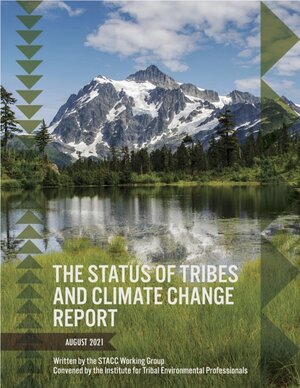
The Status of Tribes and Climate Change Report
“The Status of Tribes and Climate Change (STACC) Report seeks to uplift and honor the voices of Indigenous peoples across the U.S. to increase understanding of Tribal life, ways, cultures, and world-views; the climate change impacts Tribes are experiencing; the solutions they are implementing; and ways that all of us can support Tribes in adapting to our changing world. Given this, the STACC Report was written for diverse audiences, including Tribal managers, leaders, and community members; the authors of future National Climate Assessments; federal and state agencies and decision-makers; and nongovernmental organizations.”
Categories: Report -
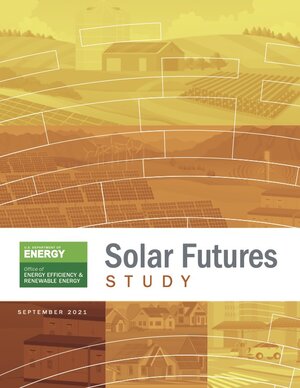
Solar Futures Study
A dramatically larger role for solar in decarbonizing the U.S. electricity system, and energy system more broadly, is within reach, but it is only possible through concerted policy and regulatory efforts as well as sustained advances in solar and other clean energy technologies.
Categories: Report -
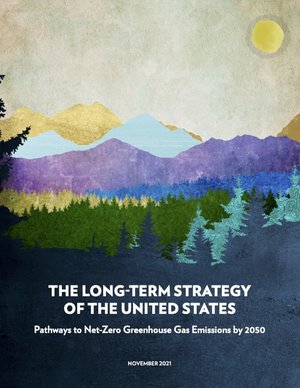
The Long-Term Strategy of the Unites States: Pathways to Net-Zero Greenhouse Gas Emissions by 2050
“Addressing the climate crisis requires immediate and sustained investment to eliminate net global greenhouse gas emissions by mid-century—and this presents a transformational opportunity for the Unites States and the world. investing in the clean technologies, infrastructure, workforce, and systems of the future creates an unprecedented opportunity to improve quality of life and create vibrant, sustainable, resilient, and equitable economies”
Categories: Report -
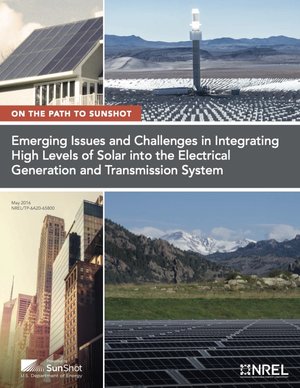
Emerging Issues and Challenges in Integrating High Levels of Solar into the Electrical Generation and Transmission System
This report examines several aspects of how the bulk power system (consisting of traditional generators and the high-voltage transmission network) may need to evolve to accommodate the increased PV penetration resulting from achievement of the SunShot cost targets.
Categories: Report -
The Role of Advancements in Solar Photovoltaic Efficiency, Reliability, and Costs
The authors of this report envision solar-energy cost reductions through lower PV module and balance-of-system (BOS) costs as well as improved system efficiency and reliability. After reviewing the recent history of PV price reductions, we demonstrate that numerous combinations of PV improvements could help complete the path to SunShot’s solar LCOE goals. This range of possibilities is created by the tradeoffs among key metrics like module price, efficiency, and degradation rate as well as system price and lifetime. For example, high module efficiency is important but probably not sufficient on its own to meet the aggressive LCOE goals. System reliability (lower degradation rates, longer system lifetimes) might be equally important.
Categories: Report