
Initiatives
Tribal Energy Programs
EPA Climate Pollution Reduction Grant Comprehensive Climate Action Plan (CCAP) Presented by the Midwest Tribal Energy Resources Association
The Midwest Tribal Energy Resources Association (MTERA) has created a Comprehensive Climate Action Plan (CCAP) to promote policies, practices, and technologies that reduce pollution, create high-quality jobs, drive economic growth, and enhance the quality of life for all Midwest Tribes. Funded by the Environmental Protection Agency (EPA) Climate Pollution Reduction Grant (CPRG), this plan focuses on reducing harmful greenhouse gas (GHG) emissions, addressing environmental injustices, and empowering community-driven solutions in Midwest Tribal communities.

To maximize the grant’s impact, MTERA partnered with eight Midwest Tribes. This plan’s analysis is grounded in the data and insight from this eight-Tribe subset of EPA Region 5 Tribes.
The results and strategies are designed to be broadly applicable to Tribes across the Midwest regardless of where each is at in their climate action planning process – providing insight on major sources of GHG emissions by sector, the relative emissions reduction impacts, benefits, and costs of measures, and the process towards their implementation.
While several sections within this CCAP are a deep dive into the analysis of the eight participating Tribes, the findings and strategies from this CCAP are designed to be broadly applicable to Tribes throughout Michigan, Minnesota, and Wisconsin.
Click the CCAP Report button below to begin exploring this resource. For a deeper dive into how to utilize this report, please review the Understanding the CCAP Webinar below as it provides an overview of each section and how it may be a helpful resource for Midwest Tribes in planning for implementing emissions reductions projects.
How to Read the CCAP
The CCAP is not meant to be read front to back in one sitting. Instead, it functions as a living reference tool—something you return to when exploring new projects, preparing grant proposals, or making community decisions. Section 1.2: How to Read this Report & Summary of CCAP Sections provides an overview of each section and how it may be a helpful resource for Midwest Tribes in planning for implementing emissions reductions projects.
using the CCAP effectively:
- Start with Section 1.2, which offers a roadmap to the rest of the document. It outlines the purpose of each section and how they support climate action planning.
- Use the PDF Bookmarks and Hyperlinks to quickly navigate to sections that are most relevant to your Tribe—whether that’s data on GHG emissions, funding sources, or specific reduction strategies.
- Reference Appendices A–F for in-depth technical methods and supporting analyses.
Based on the findings from this CCAP, MTERA has developed a GHG Emissions Reduction Measures tool that can be used by all Michigan, Minnesota, and Wisconsin Tribes to provide estimates of GHG reductions, cost estimates, and cost per emissions reduced associated with specific implementation activities of MTERA priority measures. This tool is intended to support CPRG project selection.
For more details on how to best utilize this report, along with the GHG Emissions Reduction Measures tool, please read the CCAP report.
Additional Resources
- Understanding the CCAP Webinar slide deck.
- Priority Climate Action Plan
- Priority Climate Action Plan Combined Appendices (This document is now outdated with the publishing of the CCAP. For the most up-to-date information please refer to the CCAP instead.)
For more information, please contact:
David Waybenais, Tribal Energy Program Manager
Email: david.waybenais@mtera.org
PV-SuCCESS Program
The PV-SuCCESS program is a national research initiative led by the Great Plains Institute that examines how large-scale and community-scale solar energy development affects both ecological and cultural ecosystem services in host communities. The program takes a holistic approach by evaluating physical services—such as soil health, habitat quality, and water resources—alongside cultural services, including viewsheds, recreational opportunities, spiritual values, and local economic impacts.
Research and Engagement Methods
This ensures that Tribal perspectives guide the development of tools and best practices that will shape how solar projects are sited and evaluated in the future.
Ultimately, PV-SuCCESS aims to inform permitting, planning, and development processes by integrating community values into decision-making, fostering equitable outcomes for both energy producers and the communities in which they operate.
For more information, please contact:
David Waybenais, Tribal Energy Program Manager
Email: david.waybenais@mtera.org
Home Electrification and Appliance Rebates (HEAR) Program
**The MTERA HEAR team has submitted a HEAR tribal consortium application. More details will be shared with Member Tribes as they become available. If you or your Tribe have any questions regarding the HEAR program, application, etc., please email contactus@mtera.org.
Program Overview
The U.S. Department of Energy’s Home Electrification and Appliances Rebate (HEAR) Program (Inflation Reduction Act section 50122) is focused on efficient electrification projects for low-to-moderate income (LMI) households, defined as households with income less than 150% of the area median.
The Tribal Home Electrification and Appliance Rebates (HEAR) program offers Tribes the opportunity to upgrade the energy infrastructure in their Tribal households and enhance residential efficiency.
HEAR will help Tribal households save money on energy bills, upgrade to clean energy equipment, improve energy efficiency, improve their comfort, support a stable power grid, and reduce indoor and outdoor air pollution. Eligible households can receive up to $14,000 in product rebates and 50% to 100% of project costs (e.g., installation).
Eligible Technologies Include:
- Heat pump water heater
- Heat pump for space heating and cooling
- Electric heat pump clothes dryer
- Electric stove, cooktop, range, or oven
- Electric load service center
- Insulation, air sealing, and ventilation
- Electric wiring
Tribal Participation Benefits
- Reduced energy bills for Tribal members (~5% to 25%)
- Rebates/discounts applied at point of sale
- Increased home comfort and air quality
- Economic development
- Local contractor training
- Capacity building
- Turnkey program operation, efficiency
- Greater participation in other programs (e.g., Solar for All)
- Improved local grid resilience
The Midwest Tribal Energy Resources Association (MTERA) intends to apply to the HEAR program on behalf of a consortium of MTERA Member Tribes. A Tribal Consortium is defined as two or more Indian Tribes that have designated a single Indian Tribe to act on their behalf as lead Indian Tribe of the Tribal Consortium. The Tribal Consortium can pool resources and collaborate to implement the program. Each Tribe is entitled to its own allocation and may pursue the HEAR program independently.
MTERA will collaborate with Slipstream and our Consortium Members to develop customized plans that focus on each Tribe’s unique needs and goals. Our primary objective is to prepare Tribes for solar readiness, ensuring that when Solar for All funds become available, they can take full advantage without needing additional rewiring, insulation, or similar work.
Member Tribes who wish to access the required HEAR documents or watch the replay from the informational webinar hosted by the MTERA Team can access this information through the MTERA Info Hub to learn more about this funding opportunity!
For more information, please email: contactus@mtera.org
SolWEB Program
The Ground Mounted Solar and Soil-Related Ecosystem Services project (Solar Soil for short), led by Argonne National Laboratory, is a research initiative with goals for:
(1) Developing a Recommended Methods Report for quantifying important characteristics of soils at solar facilities, particularly soil carbon storage, soil health, and pollutants such as metals and pesticides.
(2) Establishing a National Solar Soil Database for carbon and other important soil constituents in solar facility soils. The Database will contribute to the understanding and communication of ecosystem costs and benefits of various site management options.
As part of this effort, the project supports soil sampling at solar facilities. These field visits, conducted by project staff over the course of 1–2 days, use standardized, stakeholder-reviewed methods to collect and analyze soil samples. The data collected are analyzed by approved laboratories and shared through the database to support broader research and decision-making in the solar industry. Note – data are anonymized as requested by each participating Tribe).
MTERA’s role in this project includes support in coordinating with Tribal solar facilities and aiding outreach and education efforts for Tribal communities.
This collaboration aims to provide Tribes with valuable data about their solar sites, increase Tribal representation in clean energy research, and contribute to a deeper understanding of how solar development can align with soil and water health goals.
For more information, please contact:
David Waybenais, Tribal Energy Program Manager
Email: david.waybenais@mtera.org
MTERA-EPA Tribal Indoor Air Quality Corsi Cube Program
Program Overview
The Midwest Tribal Energy Resources Association (MTERA), in partnership with the U.S. Environmental Protection Agency (EPA), is excited to announce a new Indoor Air Quality (IAQ) Program for Tribal Nations.
This initiative aims to support Tribes in improving indoor air conditions by constructing and using Corsi Cubes, do-it-yourself (DIY) air purifiers.
Funding for this program is limited. Participation will be granted on a first-come, first-serve basis.
What is a Corsi Cube?
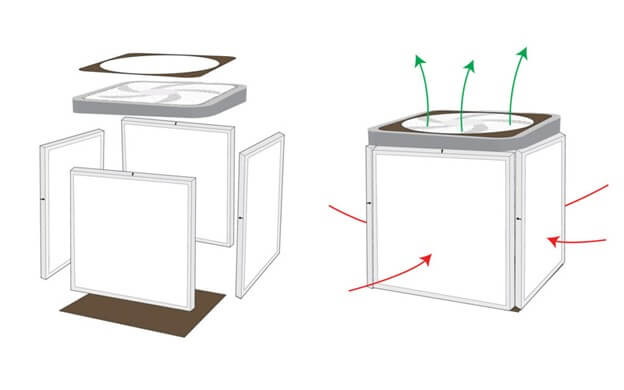
- Corsi Cubes are simple, affordable, and effective air filtration systems made by taping together four 20″x20″ MERV-13 furnace filters and attaching a 20″ box fan to the top.
- When turned on, the fan pulls air through the filters, reducing harmful indoor particles such as wildfire smoke, dust, and airborne viruses.
- These purifiers offer a low-cost alternative to commercial HEPA systems. They are ideal for use in homes, community centers, schools, and offices.
What’s included in the Program?
Through this program, MTERA will offer $3,000 sub-awards to each participating Tribe to support the construction and deployment of approximately 20 to 30 Corsi Cubes.
This is a DIY program. The air purifiers must be built by Tribal staff or community members, not purchased pre-assembled.
To ensure compliance with federal grant requirements, funds can ONLY be used for eligible materials directly related to building Corsi Cubes.
Eligible materials include:
- box fans
- MERV-13 filters
- duct tape
- cardboard
- tape and other basic assembly supplies
Funds may NOT be used for labor, staffing costs, consultant fees, administrative overhead, or unrelated equipment or services.
This hands-on initiative is designed to build community capacity and protect public health, especially during wildfire smoke events or in settings with poor indoor ventilation.
How to Participate?
The grant period is from 10/01/2024 – 09/30/2027. Participation in this IAQ Program is simple.
- Interested Tribal Nations must first sign and return the sub-award agreement provided by MTERA.
- Once enrolled, Tribes will receive funds upfront to support the construction and deployment of Corsi Cubes air purifiers in homes or community spaces such as schools, offices, or gathering centers.
- After deployment, Tribes must submit the following documentation:
- itemized receipts for all eligible material purchases
- photographs of the completed air purifiers
- a brief summary of how and where the purifiers were deployed
For more information, please contact:
David Waybenais, Tribal Energy Program Manager
Email: david.waybenais@mtera.org