
Resource Library
-
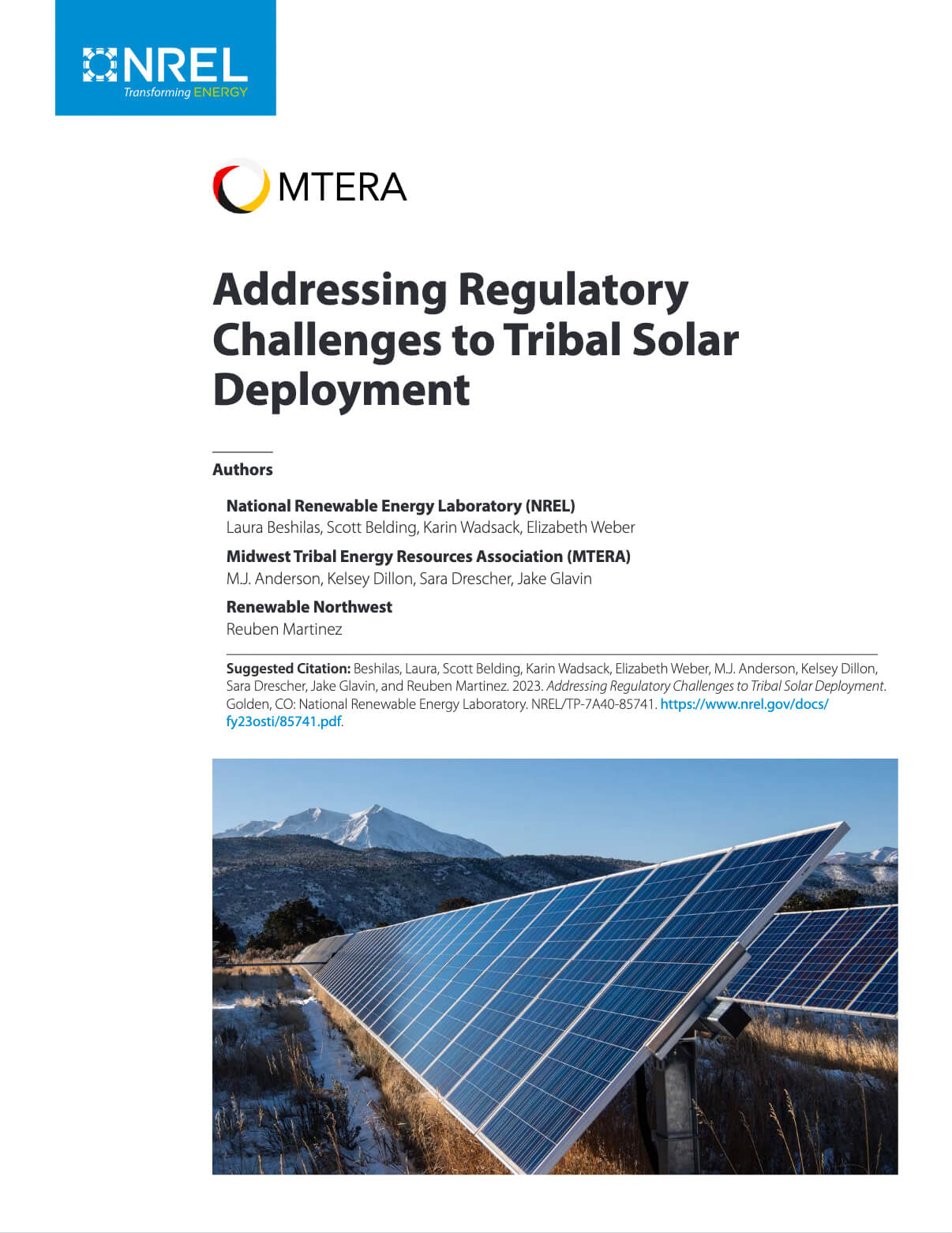
Addressing Regulatory Barriers to Tribal Solar Deployment
“Tribal land in the United States represents approximately 2% of the country’s total landmass and holds more than 5% of solar photovoltaic (PV) potential (Doris, Lopez, and Beckley 2013). This resource is largely untapped. Many Tribes are actively seeking to engage in solar development; a review of 35 Tribal strategic energy plans in 2019 revealed that 32 of 35 Tribes were exploring solar options for their communities. Many Tribes also cited regulatory hurdles to achieving these goals. This project, Addressing Regulatory Challenges to Tribal Solar Deployment, seeks to unlock some of this potential by bringing Tribal, regulatory, utility, and other stakeholders together to articulate key barriers to Tribal solar adoption and develop replicable solutions. By increasing institutional capacity and developing frameworks, trainings, and a targeted technical document repository for regulatory bodies, utilities, and Tribes, this project can help expand an emerging market.”
The collaborative efforts between National Renewable Energy Laboratory (NREL), Midwest Tribal Energy Resources Association (MTERA), the “Addressing Regulatory Challenges to Tribal Solar Deployment Guidebook” has been officially published! We couldn’t have completed this project without the many contributions; from case study interviews, one on one conversations, and listening sessions. Miigwech – Thank you to everyone that contributed to this amazing project!
Categories: GuidebookTags: Community Solar -
The Solarize Guidebook: A Community Guide to Collective Purchasing of Residential PV Systems
“This guidebook is intended to be a roadmap for project planners and solar advocates who want to create their own successful Solarize campaigns. It describes the key elements of the Solarize Portland campaigns and variations from projects across the country, along with lessons learned and planning templates.”
Categories: Guidebook -
A Guide to Community Shared Solar: Utility, Private, and Nonprofit Project Development
“This guide is a resource for those who want to develop community shared solar projects, from community organizers or solar energy advocates to government officials or utility managers. By exploring the range of incentives and policies while providing examples of operational community shared solar projects, this guide will help communities plan and implement successful energy projects. In addition, by highlighting some policy best practices, this guide suggests changes in the regulatory landscape that could significantly boost community shared solar installations across the nation.”
Categories: Guidebook -
Solar Futures Study
A dramatically larger role for solar in decarbonizing the U.S. electricity system, and energy system more broadly, is within reach, but it is only possible through concerted policy and regulatory efforts as well as sustained advances in solar and other clean energy technologies.
Categories: Report -
Navajo Residential Solar Energy Access as a Global Model
Here, this case study focuses on the Navajo Nation’s efforts to provided residential power access through solar photovoltaic systems to some of its approximately 34,000 remote off-grid tribal members. The solution the Nation has adopted in collaboration with Sandia National Laboratories offers insights into how the Navajo Tribal Utility Authority’s work could serve as a residential model to meet the needs of the 1.2 billion people globally who are without electrical residential power.
Categories: Case Study -
Solar Photovoltaic Financing: Residential Sector Deployment
Financing the cost of a residential photovoltaic (PV) system remains a challenge despite the various financial incentives available to homeowners at both the state and federal level. Traditionally, homeowners installing residential PV systems have used home equity loans, mortgage loans, or cash in combination with federal, state, and utility incentives to finance the total cost of the system, all of which are briefly described. More recently however, a number of new financial models have been developed to lower the financial burden associated with the installation of a residential PV system:
Categories: Technical Report -
On the Path to Sunshot: Executive Summary
Solar technology, solar markets, and the solar industry have changed dramatically over the past five years. Cumulative U.S. solar deployment has increased more than tenfold, while solar’s levelized cost of energy (LCOE) has dropped by as much as 65% (Figure 1). As a result, today the solar industry is about 70% of the way towards achieving the Initiative’s 2020 goals. New challenges and opportunities have emerged as solar has become much more affordable, and we have learned many lessons as solar technologies have been deployed at increasing scale in the United States and abroad. The On the Path to SunShot series explores the remaining challenges to realizing widely available, cost-competitive solar in the United States.
Categories: Study